The EU single market promises one customer base of 450 million people, but businesses that try to sell online into other member states keep running into the same wall. It is not tax paperwork and it is not language. Eurostat’s enterprise survey shows that the cost of shipping parcels to other countries, and getting them back, is the problem cited most often by cross-border web sellers, by a wide margin. For retailers, it is cited by a clear majority.
This study looks at five rounds of Eurostat’s data on cross-border web sales difficulties, covering sales years 2016 to 2024, and breaks them down by obstacle, company size, industry and country.
Key findings
- 28.2% of EU businesses that sold online to other EU countries in 2020 said high delivery or return costs made it difficult. That is 1.7 times the share that named the next obstacle, the VAT system (16.7%).
- Among retailers, the figure was 57.8%. More than two in three cross-border retail web sellers (67.5%) hit at least one difficulty, compared with 42.7% across all industries.
- The share reporting any difficulty rose from 37.6% in 2016 to 42.7% in 2020, and delivery cost complaints rose in each survey round, from 25.6% to 28.2%.
- Language is the only obstacle that shrank, from 12.2% of cross-border sellers in 2016 to 10.0% in 2020.
- Small firms feel delivery costs most: 28.8% of firms with 10 to 49 employees named them, against 24.4% of firms with 250 or more.
- Delivery accounts for about two thirds of the problem: of the businesses that reported any difficulty in 2020, around 66% named delivery or return costs.
- There is no common trend since 2020. In the 14 countries with data for both 2020 and 2024, delivery cost complaints rose in seven and fell in seven. Portugal nearly doubled, from 18.9% to 37.7%.
How we analyzed the data
The figures come from the European Commission’s survey on ICT usage and e-commerce in enterprises, published by Eurostat as the isoc_ec_wsobs dataset (by company size) and isoc_ec_wsobsn2 (by industry). The survey covers enterprises with 10 or more employees outside agriculture, mining and finance.
Three definitions matter:
- Web sales means orders placed through a website, an app or an online marketplace. EDI-type sales between systems are excluded.
- Cross-border web sellers are the businesses that made web sales to customers in at least one other EU country. All percentages in this study use them as the base, unless stated otherwise.
- Years: the e-commerce questions in the survey refer to the previous calendar year. The 2021 survey describes 2020 sales, so we label results by the sales year, not the survey year.
The question was asked in the 2017, 2019, 2021, 2022 and 2025 surveys. Eurostat publishes an EU total only up to the 2021 survey (2020 sales). For 2021 and 2024 sales, only country results are available. The question on VAT was added in the 2021 survey, so it has no earlier history.
We excluded Romania from country comparisons. Its published results show 100% of cross-border web sellers reporting at least one difficulty in 2020 and 2021, which points to a routing difference in the national questionnaire rather than a real result. We also left out Malta’s 2024 figures, which jump to 93.7% from 50.8% for 2021 sales.
Delivery costs lead every other obstacle
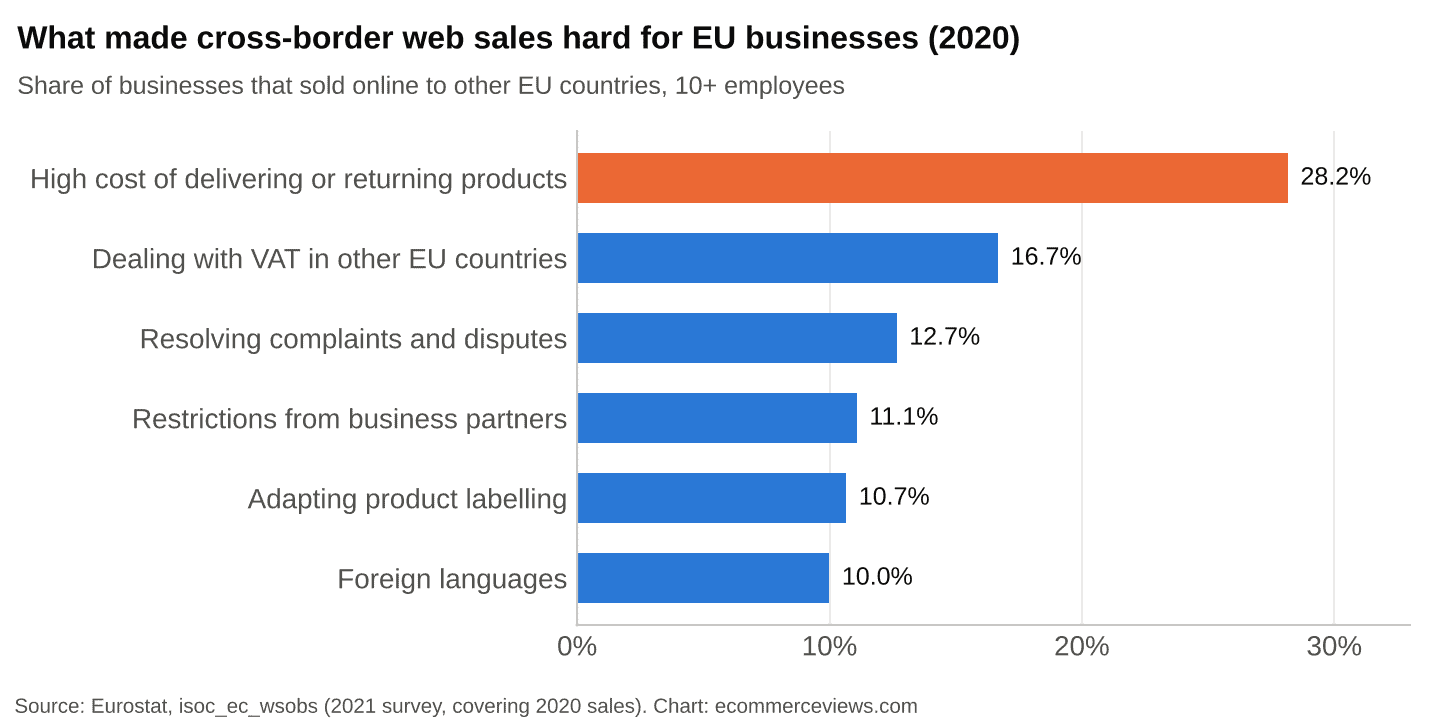
Out of six listed difficulties, delivery and return costs top the list in the EU total and in almost every country. In 2020, 28.2% of cross-border web sellers named them. VAT was second at 16.7%, and the remaining four obstacles each sat between 10% and 13%.
What made cross-border web sales hard for EU businesses in 2020
The gap is the important part. VAT, labelling rules and contract restrictions are what most policy debates about the single market focus on. Yet for the businesses that already sell across borders, each of those affects roughly one in ten. The cost of moving a parcel affects more than one in four.
The 2020 figures also show how concentrated the problem is. Of the businesses that reported at least one difficulty, about two thirds named delivery or return costs. In other words, if you removed every obstacle except shipping, most of the businesses that struggle would still struggle.
| Difficulty (share of cross-border web sellers) | 2016 | 2018 | 2020 |
|---|---|---|---|
| High cost of delivering or returning products | 25.6% | 26.5% | 28.2% |
| VAT system in other EU countries | n/a | n/a | 16.7% |
| Resolving complaints and disputes | 11.2% | 10.5% | 12.7% |
| Restrictions from business partners | 8.4% | 8.5% | 11.1% |
| Adapting product labelling | 9.7% | 10.3% | 10.7% |
| Lack of knowledge of foreign languages | 12.2% | 10.5% | 10.0% |
| At least one difficulty | 37.6% | 36.2% | 42.7% |
| No difficulty | 60.1% | 62.9% | 56.1% |
EU-27, enterprises with 10 or more employees. Source: Eurostat isoc_ec_wsobs.
Two shifts stand out over the three EU rounds. First, delivery cost complaints rose in every round, by 2.6 percentage points in total. Second, the share of cross-border sellers with no difficulty at all fell from 62.9% in 2018 to 56.1% in 2020. Part of that drop is mechanical, since the 2021 survey added VAT as a new answer option. But complaints about disputes and partner restrictions rose too, so the extra option does not explain all of it.
Language barriers moved the other way. Machine translation, multilingual shop templates and marketplaces that handle translation have made it far easier to present a store in another language, and the data reflects it.
Retailers carry the heaviest burden
The EU total blends retailers with manufacturers, IT firms and hotels, and their problems are very different. A hotel selling rooms to German guests ships nothing. A clothing store selling to German customers ships every order and receives a share of it back.
Share of cross-border web sellers citing high delivery or return costs, by sector
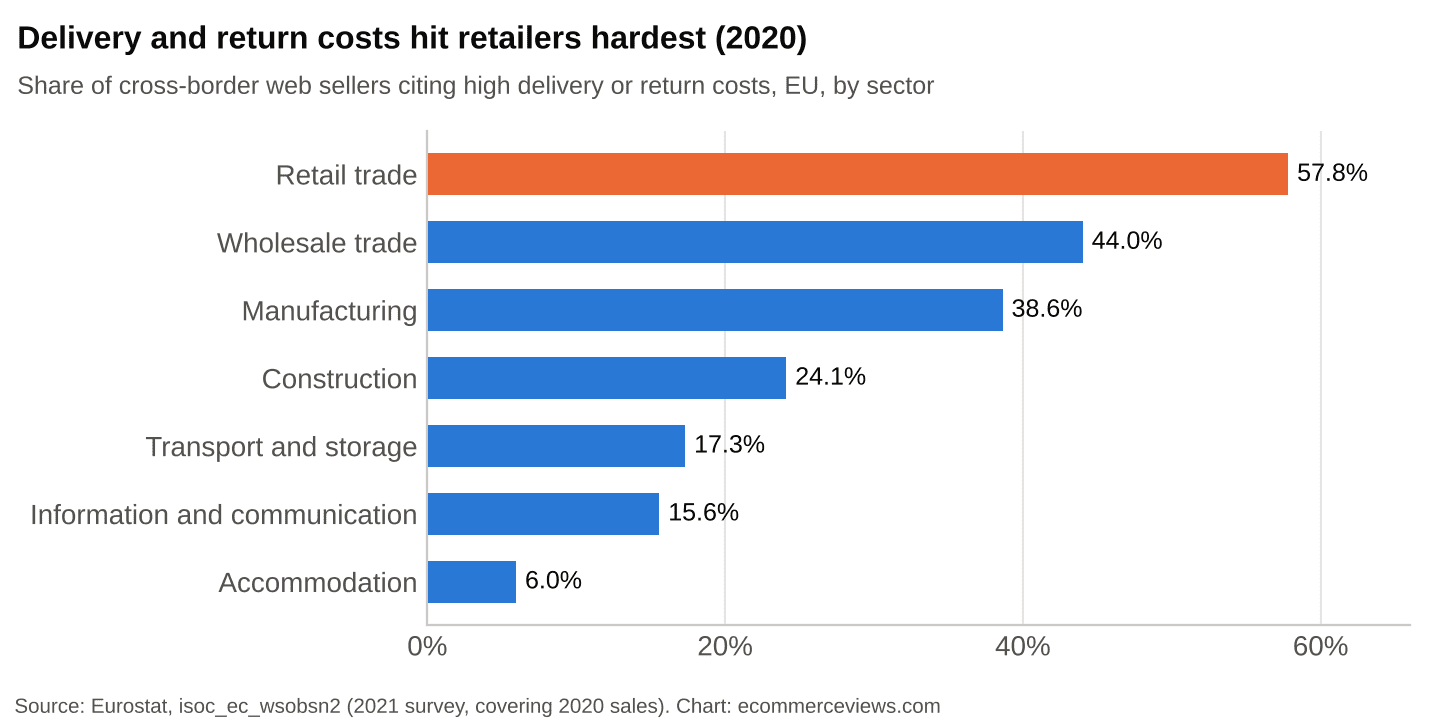
In 2020, 57.8% of cross-border retail web sellers said delivery or return costs made selling abroad difficult. That is more than double the all-industry rate. Wholesale (44.0%) and manufacturing (38.6%) follow. At the bottom, only 6.0% of accommodation businesses named delivery costs, which makes sense for a sector that sells stays, not parcels.
Retailers also reported more of every other problem:
| Obstacle, 2020 | Retail trade | All industries |
|---|---|---|
| High delivery or return costs | 57.8% | 28.2% |
| VAT system in other EU countries | 29.7% | 16.7% |
| Resolving complaints and disputes | 21.5% | 12.7% |
| Restrictions from business partners | 17.6% | 11.1% |
| Foreign languages | 14.8% | 10.0% |
| Adapting product labelling | 14.5% | 10.7% |
| At least one difficulty | 67.5% | 42.7% |
| No difficulty | 31.9% | 56.1% |
EU-27, enterprises with 10 or more employees. Source: Eurostat isoc_ec_wsobsn2.
Only 31.9% of cross-border retail web sellers reported no difficulty. For a retailer, selling into another EU country is the exception that works smoothly, not the rule. The same pattern appears in the delivery side of consumer complaints we covered in our analysis of problems European online shoppers run into: the friction sits in logistics more than in the storefront.
Within manufacturing, the highest delivery cost rates were in chemicals (50.8%), rubber and plastics (48.7%) and electrical equipment (46.5%). Those are heavy or regulated goods, which supports the reading that the obstacle is the physical cost of moving products, not the act of selling online.
Small businesses pay more per parcel
Large shippers negotiate contract rates with carriers. Small shops pay closer to list prices, and the data shows it.
| Company size | High delivery or return costs | Foreign languages | Product labelling |
|---|---|---|---|
| 10 to 49 employees | 28.8% | 10.7% | 10.2% |
| 50 to 249 employees | 26.3% | 7.9% | 12.3% |
| 250 or more employees | 24.4% | 6.0% | 13.1% |
EU-27, share of cross-border web sellers, 2020. Source: Eurostat isoc_ec_wsobs.
Delivery costs and language barriers fall as companies grow, which fits the idea that scale buys both cheaper shipping and in-house translation. Labelling runs the other way. Larger firms are more likely to sell regulated goods, such as food, chemicals and electronics, across many markets, so they deal with more labelling rules.
The survey does not cover businesses with fewer than 10 employees, which is where most independent online stores sit. Their delivery costs per parcel are almost certainly higher still, so the true share for the smallest sellers is likely above 28.8%.
Delivery cost is also part of why so few businesses sell across borders at all. As we found in our look at how few European businesses sell online, most never start. The ones that do quickly find that the parcel, not the website, decides whether a foreign order makes money.
Country results since 2020: no single direction
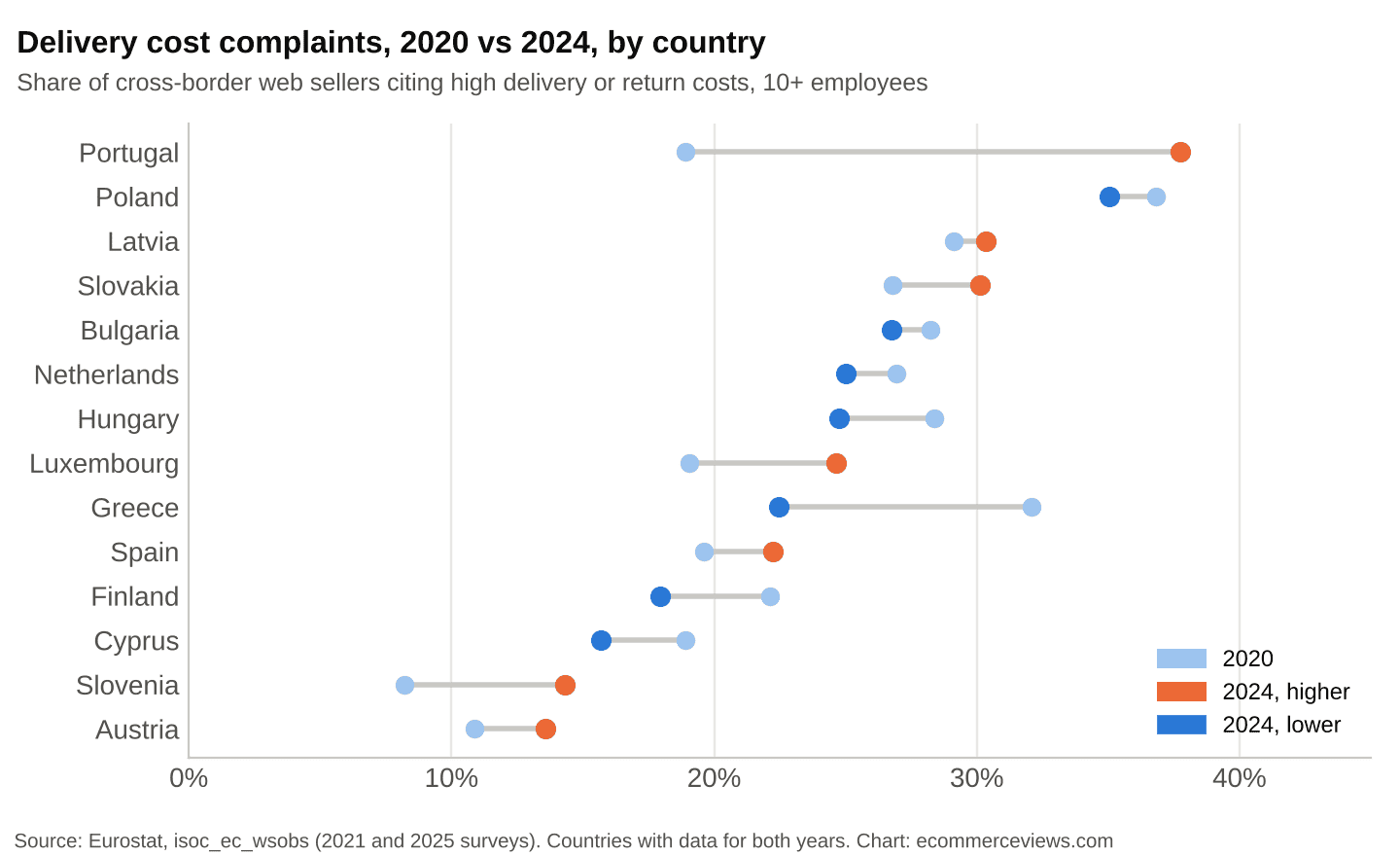
Eurostat stopped publishing an EU total for this question after the 2021 survey, but 14 countries reported delivery cost difficulties for both 2020 and 2024 sales. The picture is mixed.
Delivery cost complaints among cross-border web sellers, 2020 vs 2024
Seven countries saw delivery cost complaints rise and seven saw them fall. The largest increase was in Portugal, where the share almost doubled from 18.9% to 37.7%. Slovenia went from 8.2% to 14.3% and Luxembourg from 19.1% to 24.6%. The largest fall was in Greece, from 32.1% to 22.5%. Poland stayed among the highest at 35.0% in 2024, down slightly from 36.8%.
Germany did not report the delivery item for 2020, but its 2024 result is worth noting because it is the largest ecommerce market in the EU. 36.5% of German cross-border web sellers named delivery or return costs, and 55.2% reported at least one difficulty. German sellers also reported the VAT system (24.1%) and labelling (18.3%) far more often than the 2020 EU averages.
Geography explains part of the country spread. In 2020, the highest delivery cost shares (excluding Romania) were in Czechia (43.1%), Poland (36.8%) and Greece (32.1%). The lowest were in Slovenia (8.2%), Austria (10.9%) and Croatia (13.3%). Countries with large logistics hubs or neighbors that share carriers tend to report lower costs, while sellers far from the main parcel networks pay more per kilometer.
What changed for VAT
VAT is the second most common obstacle, but it is also the one that policy has already addressed. Since 1 July 2021, the EU VAT One Stop Shop lets online sellers register in one member state and report VAT on sales to consumers across the EU from there. It replaced the separate national distance-selling thresholds with a single EU-wide threshold of EUR 10,000.
The 2020 figures predate that change. Country results for later years do not show a clear improvement yet. The VAT share among cross-border web sellers fell in some countries between 2020 and 2024 (Finland from 15.9% to 8.1%, Austria from 5.8% to 5.5%) but rose in others (Luxembourg from 7.2% to 14.4%, Spain from 10.9% to 13.6%). The OSS made registration simpler, but sellers still have to apply the right rate for each country, and that complexity remains.
Delivery costs have had no equivalent fix. There is no single EU parcel tariff, and shipping a small parcel across a border still costs considerably more than shipping it the same distance within one country.
What this means for online stores
If you sell or plan to sell to customers in other EU countries, the data points to a clear order of priorities. Logistics should come first, because it is the obstacle most likely to stop you.
- Price shipping before you price products. Get real cross-border rates for your top three target countries, including returns, before you decide which markets to enter. A market where your parcel costs double the domestic rate may still work for high-value items but not for low-value ones.
- Use consolidated shipping where you can. Parcel consolidators and carrier aggregators let small stores access contract rates that only large shippers get directly. Our guide to international shipping and customs covers the main options.
Plan returns and order value before you launch abroad
The obstacle in the survey is “delivering or returning”. A return from another country can cost more than the outbound parcel, so the returns policy matters as much as the shipping rate.
- Decide on cross-border returns from day one. Choose whether you will offer free returns abroad, charge for them, or use a local returns address. Our view on why free returns are a bad default applies even more to cross-border orders.
- Raise the order value per parcel. Bundles, minimum order values for international shipping and free shipping thresholds set above your domestic level all spread the fixed cost of a cross-border parcel over more revenue.
Channels, tax and translation
The remaining obstacles are smaller, and some already have practical fixes.
- Consider marketplaces as a test channel. Large marketplaces run their own fulfillment networks in several EU countries. Selling there first can show you which markets have demand before you build your own logistics. Our overview of marketplace management covers the trade-offs.
- Register for the OSS early. If your cross-border B2C sales are likely to pass EUR 10,000 a year, the One Stop Shop is the simplest way to handle VAT across the EU. It removes much of the second biggest obstacle in this survey.
- Do not over-invest in translation. Language is the smallest and only shrinking obstacle. A good machine-translated store with a human-reviewed checkout and returns policy is usually enough to start.
Limits of the data
- Only businesses that already sell abroad are asked. Firms that gave up on cross-border sales, or never tried because of delivery costs, are not counted. The true deterrent effect of shipping costs is therefore larger than these shares suggest.
- Microbusinesses are excluded. The survey covers enterprises with 10 or more employees. Most small online stores fall below that line.
- The EU total stops at 2020 sales. Later years are available only for some countries, and different countries reported in different years.
- The VAT question started in 2021. The higher “any difficulty” figure for 2020 partly reflects the added answer option.
- Some national results look implausible. Romania (100% reporting a difficulty) and Malta’s 2024 figures were excluded. Small samples in small countries can also move several points between rounds.
- The survey records perceptions. A business that says delivery costs are “high” is comparing them with its own margins and expectations, not with a common benchmark. Methodology details are in Eurostat’s metadata for the survey.
The bottom line
The EU has spent years simplifying the paperwork of cross-border selling, and the VAT One Stop Shop is a real improvement. But the businesses that actually sell across borders say the bigger problem is physical: it costs too much to send a parcel to another country and to take it back. For retailers, that complaint is the majority view. Any online store planning to sell across the EU should treat shipping and returns as the first question to answer, not the last.